
How to Choose the Right Tile Cutter for Porcelain vs Ceramic
Porcelain vs ceramic tile cutting—when to use a snap cutter, wet saw, or angle grinder. Tool and blade tips for installers.
Porcelain and ceramic tile have different hardness and density, so the right cutting tool and blade matter. Here’s how to choose.
Porcelain vs ceramic
Ceramic tile is typically softer and easier to score and snap. Porcelain is denser and harder, so it’s more likely to chip or resist a snap cutter. For porcelain, a wet saw with a diamond blade is often the best option for clean, repeatable cuts. The difference comes down to composition: porcelain is fired at higher temperatures and has a lower water absorption rate, making it harder and more durable but also harder to cut with a score-and-snap method. If you’re doing a mix of ceramic and porcelain, plan on using the wet saw for most porcelain cuts and the snap cutter for simple ceramic cuts.
Tile cutter types
- Snap cutter (score and snap) – You score the tile with a wheel and snap it along the line. Best for straight cuts on ceramic and some porcelain. Fast and no water. Not ideal for curves, notches, or hard porcelain. Quality varies; a better snap cutter will handle more porcelain and produce cleaner breaks. For DIYers doing a single bathroom, a mid-range snap cutter plus a rental wet saw for the few tough cuts is a common approach.
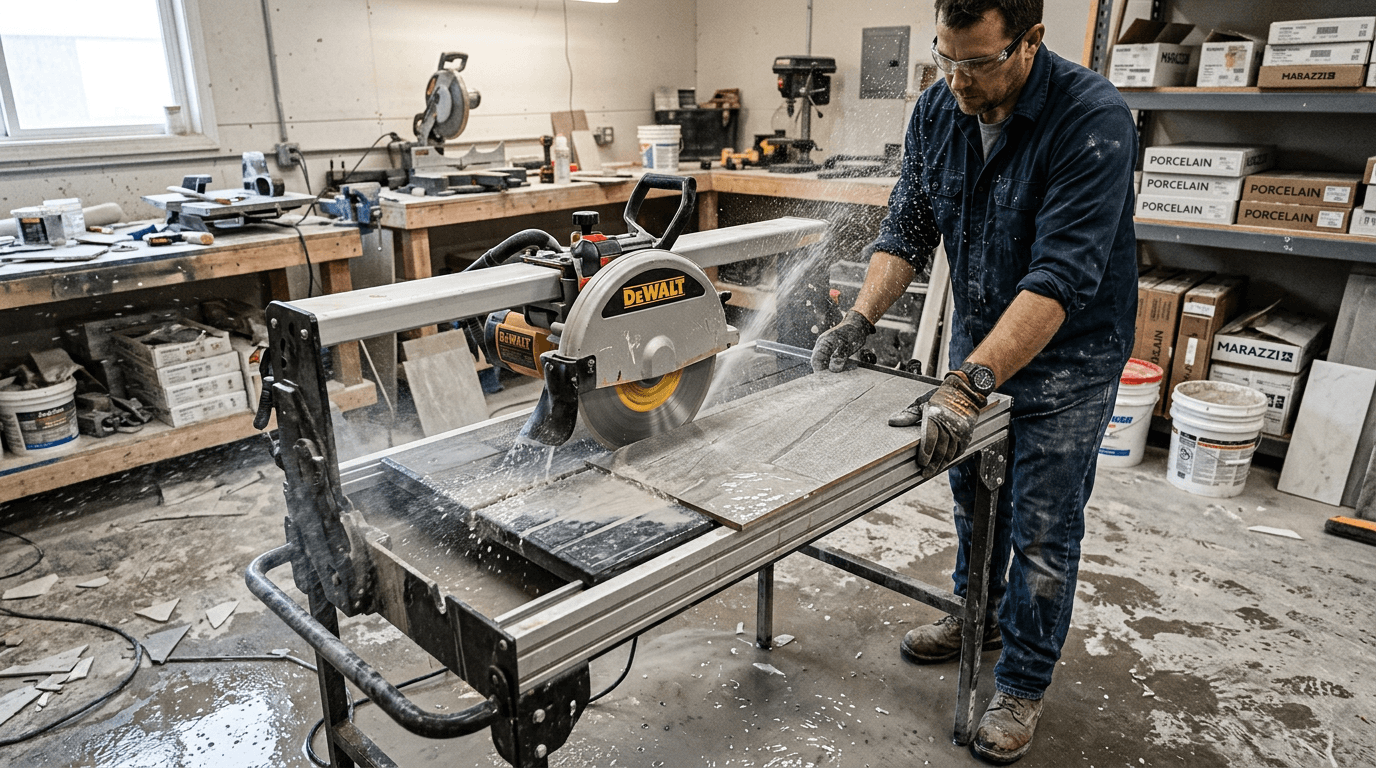
- Wet saw – A diamond blade with water cooling. Best for porcelain, diagonal cuts, notches, and large format. Produces less chipping when the blade and feed rate are right. Table size and cutting depth determine what tile sizes you can handle. Sliding tables make large-format tile easier. Professional installers typically use a wet saw as their primary cutter for porcelain and complex layouts.
- Angle grinder with diamond blade – Good for quick cuts, notches, and curves. Can create more dust and chipping than a wet saw; use a blade rated for tile and consider a guide for straight lines. Ideal for trimming around outlets, cutting curves, or making a few cuts without setting up the wet saw.
Choosing by project
For a few straight cuts on ceramic, a snap cutter may be enough. For a bathroom or kitchen with porcelain, diagonal cuts, or large format, use a wet saw and a diamond blade rated for porcelain. For small notches and curves, an angle grinder with a diamond blade is handy. Large-format tile (e.g. 24x24 or bigger) is often easier on a wet saw with a sliding table so you can support the tile and feed it steadily. For a backsplash with mostly straight cuts on ceramic, a snap cutter can handle most of the work. Match the tool to the material and the cut type to avoid frustration and wasted tile. If you’re doing one bathroom with a mix of ceramic and porcelain, renting a wet saw for the weekend and using a snap cutter for the simplest ceramic cuts is a practical approach. For full-time installers, owning a quality wet saw and a good snap cutter covers almost every job.
Blade and saw care
Use a blade suited to the material (ceramic vs porcelain). Keep the blade cool with water on a wet saw. Replace the blade when cuts slow down or chip more than usual. Clean the water tray and pump periodically to avoid buildup. For snap cutters, replace the scoring wheel when it no longer scores cleanly or when the tile starts to chip along the break line. A worn blade or wheel wastes tile and time—replacing it before it’s completely shot will give you cleaner cuts and fewer breakages. Store wet saw blades in a dry place when not in use to avoid rust and prolong life.
Wet saw blade choice
For a wet saw, use a continuous-rim or turbo diamond blade rated for porcelain or tile. Continuous rim gives the cleanest edge with minimal chipping; turbo can cut a bit faster and is also suitable for porcelain. Avoid using a segmented concrete blade on tile—it will chip. Match the blade diameter to your saw and keep the water flowing so the blade stays cool.
Snap cutter tips
Score once with firm, even pressure; don’t go back and forth multiple times. Use the breaker to snap along the score line. For porcelain, some snap cutters have a higher leverage or a different wheel; read the instructions. If the tile chips or doesn’t break cleanly, a wet saw may be the better option for that cut.
When to use which tool
- Snap cutter – Straight cuts on ceramic, some porcelain, small jobs, no water needed. Fast for simple cuts. Best when you have many similar straight cuts and the material is not too hard.
- Wet saw – Porcelain, diagonal cuts, notches, L-cuts, large format, and any cut where a snap cutter struggles. Uses water and a diamond blade. The default choice for professional installers doing full bathrooms or kitchens with porcelain.
- Angle grinder – Quick notches, curves, and trim cuts. More dust and often more chipping than a wet saw; use with a tile-rated diamond blade and consider a guide for straight lines. Great for cutting around toilet flanges, pipes, and irregular edges without setting up the wet saw.
Buying tips
- For mostly ceramic and simple straight cuts, a good snap cutter can be enough. For porcelain and complex cuts, plan on a wet saw.
- When buying a wet saw, check the cutting capacity (tile size and depth) and whether it has a sliding table for large format.
- For wet saw blades, choose “porcelain” or “tile” rated; continuous rim for the smoothest edge.
Common mistakes
- Using a dull or wrong blade on a wet saw – A worn or concrete blade will chip porcelain. Use a sharp, tile-rated blade.
- Skipping water on a wet saw – The blade needs water for cooling and to reduce chipping. Don’t run the saw dry.
- Forcing a snap cutter on hard porcelain – If it doesn’t break cleanly, switch to a wet saw instead of forcing and risking breakage.
- Cutting too fast on a wet saw – Let the blade feed at a steady rate. Rushing increases chipping.
Summary
Ceramic is softer and often works with a snap cutter; porcelain is harder and usually benefits from a wet saw with a diamond blade. Choose the tool and blade for your material and the type of cuts you need. Use a snap cutter for simple straight cuts, a wet saw for porcelain and complex work, and an angle grinder for notches and curves. Keep blades cool and replace them when performance drops. Investing in the right cutter and a quality diamond blade for your wet saw will reduce breakage, improve edge quality, and make the job faster. We carry tile tools and tile blades so you can match the tool and blade to your project. For porcelain and complex cuts, a wet saw with a continuous-rim or turbo diamond blade is the standard; for simple ceramic cuts, a snap cutter can be enough. Match the tool to the material and the cut type for the best outcome. Porcelain will almost always benefit from a wet saw and a diamond blade rated for porcelain; ceramic can often be handled with a snap cutter for straight cuts. When you need notches, curves, or diagonal cuts, the wet saw and sometimes an angle grinder with a tile blade will complete the job. Choosing the right combination reduces breakage and saves time. A quality wet saw with a sharp diamond blade will handle most porcelain and complex cuts; add a snap cutter for quick ceramic cuts and an angle grinder with a tile blade for notches and curves. That trio covers the vast majority of residential and light commercial tile installations. Start with the right tool for your material and cut type, and you’ll get cleaner results with less waste.
Where to shop
We carry wet tile saws and diamond blades for tile and porcelain. Shop our tile tools and tile blades categories to find the right saw and blade for your project.
Next step
Shop the category that matches your job, or keep reading in the guides hub.
FAQ
- Can I use a snap cutter on porcelain?
- Porcelain is harder than ceramic; many snap cutters struggle with it or cause chipping. For straight cuts on some porcelain, a quality snap cutter can work. For diagonal cuts, notches, and hard porcelain, a wet saw with a diamond blade is more reliable.
- Best blade for porcelain tile?
- Use a continuous-rim or turbo diamond blade rated for porcelain. Keep the blade cool with water (wet saw) to reduce chipping and extend life.
- Wet saw vs snap cutter for ceramic?
- For simple straight cuts, a snap cutter is fast and doesn’t require water. For L-cuts, notches, diagonals, and large format, a wet saw gives more control and fewer breaks.