
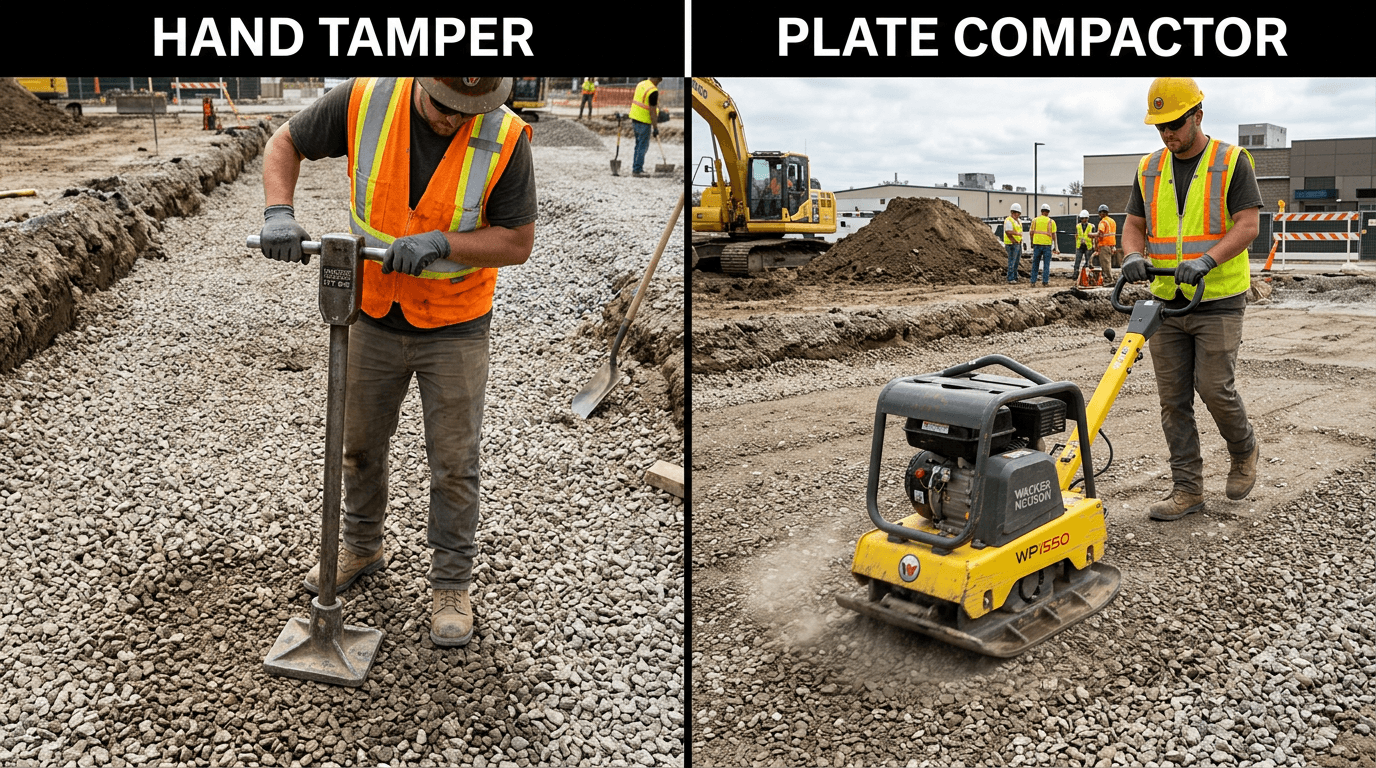
Hand Tamper vs Plate Compactor - Which to Use When
When to use a hand tamper versus a plate compactor for soil, gravel, and pavers. Pros, cons, and project-based advice.
When you need to compact soil, gravel, or base material, the right tool saves time and ensures a stable result. Two of the most common choices are the hand tamper and the plate compactor. Here’s when to use each and how they differ.
What is a hand tamper?
A hand tamper (sometimes called a hand compactor or tamping tool) is a handheld tool with a flat or slightly convex metal base. You lift and drop it repeatedly to compact the material. It’s ideal for small areas, tight spaces, edges next to walls, and paver base where a machine can’t fit. Hand tampers are inexpensive, require no fuel or power, and give you precise control. The downside is that they’re slow and physically demanding for anything more than a few square feet.
What is a plate compactor?
A plate compactor (or vibrating plate) uses an engine to vibrate a metal plate. The vibration densifies granular materials like sand, gravel, and crushed stone. Plate compactors cover ground quickly and are the standard for driveways, patio base, and large flat areas. They come in different sizes and weights; heavier plates compact deeper. You need fuel (or electricity for electric models) and space to run the machine. They’re not ideal for cohesive (clay) soil—for that, an impact rammer (jumping jack) is often better.
Side-by-side comparison
- Area size: Hand tamper for small patches, edges, and corners. Plate compactor for driveways, patios, and large base prep.
- Material: Hand tampers work on soil and paver base in thin lifts. Plate compactors excel on granular materials (gravel, sand, crushed stone) and are less effective on cohesive soil unless it’s very thin.
- Speed: A plate compactor is much faster for anything beyond a few square feet.
- Cost: Hand tampers are low cost; plate compactors are a larger investment but save labor on bigger jobs.
- Access: Hand tampers go anywhere; plate compactors need a path and space to maneuver.
Which should you choose?
For a small project—e.g. a few pavers, a post hole, or an edge—use a hand tamper. For a driveway, a full patio base, or any large granular area, use a plate compactor. For trenches and backfill, consider a jumping jack (tamping rammer) instead of a plate. If you’re doing a mix of work, a hand tamper plus a plate compactor (or rental) covers most residential and light commercial needs. Think about the total square footage, the type of material (granular vs cohesive), and whether you have room to run a machine. When in doubt, use the hand tamper for anything under about 50 square feet or where access is tight; use the plate for everything else granular and large.
Safety and tips
With a hand tamper, wear sturdy boots and avoid striking your feet. With a plate compactor, keep hands and feet clear of the plate, use ear protection, and follow the manufacturer’s guidelines for fuel and operation. Compact in layers (lifts) rather than in one thick layer for best density. For plate compactors, add water sparingly to granular base if the material is too dry to compact well—too much water can make it mushy. For hand tampers, work in a grid pattern and overlap passes slightly for even compaction.
Rent vs buy
Hand tampers are cheap enough that buying one makes sense for most homeowners and contractors who do any paver or post work. Plate compactors are more expensive; for a single driveway or patio, renting is often the better choice. If you do several compaction jobs a year or run a landscaping or paving crew, owning a plate compactor pays off. Many rental yards carry both gas and electric plate compactors—electric is quieter and avoids fuel but requires a power source. When renting, ask about plate size and centrifugal force so you get a unit that’s appropriate for your project. A small plate is easier to maneuver but may take more passes; a large plate covers more ground per pass but may be overkill for a small patio.
Buying tips
- For hand tampers, choose a base size that fits your typical work (e.g., post holes vs paver edges). A larger base covers more area per drop but may be harder to use in tight spots.
- For plate compactors, consider plate size (square inches), centrifugal force (often listed in pounds or kN), and whether you need gas or electric. Heavier units compact deeper but are harder to move.
- If you compact near structures or existing pavement, look for units with adjustable amplitude or rubber pads to reduce transmitted vibration.
Common mistakes
- Using a plate compactor directly on pavers – This can crack or dislodge pavers. Compact the base before laying pavers; for sand between pavers, use a plate with a rubber mat or a paver-specific attachment.
- Compacting in one thick lift – Both hand tampers and plate compactors work best in 2–4 inch lifts. Add material, compact, then add more. One thick layer won’t compact evenly.
- Using a plate on cohesive (clay) soil – Plates work on granular material. For clay or cohesive soil, use a jumping jack (tamping rammer) instead.
- Skipping PPE – Plate compactors are loud; use hearing protection. Wear boots and keep hands and feet clear of the plate.
Project examples
- Small patio or walkway – Hand tamper for edges and tight areas; consider renting a plate for the main base if the area is more than a few square yards. For a tiny area (e.g. 20 square feet), a hand tamper alone may be enough.
- Driveway – Plate compactor for the full base. Hand tamper for edges next to the house or curb where the machine can’t reach. Compact the subgrade first, then add base material in lifts and compact each lift.
- Post holes and footings – Hand tamper to compact backfill around posts; use in layers. Don’t use a plate compactor in a narrow trench or post hole—the hand tamper is the right tool.
- Paver driveway or patio – Plate compactor on the subbase and base course before laying pavers. After pavers are down, use only a plate with a rubber mat or a paver roller, and follow best practices to avoid damage. Never run a bare metal plate directly on installed pavers.
Summary
Hand tampers are manual, low-cost tools for small areas and tight spaces; plate compactors are engine-driven and ideal for larger granular base work. Match the tool to the project size and material. Compact in lifts, use the right tool for the soil type, and protect your hearing and feet. For one-off large jobs, rent a plate compactor; for frequent use, consider buying. We carry both so you can choose the right option for your project. Whether you’re compacting base for a few pavers or a full driveway, using the right tool and technique ensures a stable, long-lasting result. Compact in lifts, avoid using a plate directly on pavers, and choose a hand tamper for small or tight areas and a plate compactor for large granular base. We carry compaction equipment so you can find the right tool for your project size and budget. Hand tampers are available in several base sizes and weights; plate compactors come in gas and electric models with a range of plate sizes and centrifugal force. If you’re unsure which size or type you need, contact us and we can help you choose based on your project and material. Hand tampers and plate compactors are both essential for quality base prep—picking the right one for the job makes the work faster and the result more durable.
Where to shop
We carry hand tampers and plate compactors so you can choose the right tool for your project. Browse our compaction equipment category or contact us if you’re unsure which size or type you need.
Next step
Shop the category that matches your job, or keep reading in the guides hub.
FAQ
- Can I use a plate compactor on pavers?
- Plate compactors can crack pavers if used directly on top. Use a plate compactor on the base before laying pavers, or use a rubber pad and low amplitude. For compacting sand between pavers, use a plate with a rubber mat or a vibrating plate designed for pavers.
- How many passes with a hand tamper?
- For small areas and paver base, several passes in a grid pattern are typical. Compact in 2-4 inch lifts; add material and compact again. The goal is consistent density with no visible bounce or loose spots.
- What is the main difference between a hand tamper and a plate compactor?
- A hand tamper uses manual impact to compact small areas and is best for edges, corners, and light work. A plate compactor uses engine-driven vibration and is best for larger areas and granular materials like gravel and sand.